Fraud detection via edit history
Background Information
The widespread availability of artificial intelligence tools, such as ChatGPT, has introduced significant challenges for educational assessment, particularly concerning graded homework sets. In the Mathematics and Computer Science department, specifically within the Algorithms cluster, courses rely heavily on homework assignments to cultivate vital theoretical skills. These rigorous assignments give students the necessary time to work through deep, complex problems that demand high levels of creativity and critical thinking to formulate solutions. However, the temptation to use artificial intelligence to complete these tasks threatens the educational value of homework, as students may entirely bypass the essential learning process by submitting generated answers. Past experiences in earlier iterations of these courses have clearly indicated that without effective countermeasures, take-home assignments are no longer a reliable instrument for training theoretical skills or keeping students motivated. Alternative methods to combat fraud, such as mandatory weekly in-person evening tests or requiring handwritten paper submissions, are considered highly invasive. These conventional mitigation strategies compromise the flexibility of a hybrid learning environment and place an immense strain on both students and teaching staff. There is an urgent need for an innovative technological solution that preserves the pedagogical benefits of remote homework assignments. Such an approach must allow students to learn at their own pace and from their own preferred environment without compromising the fundamental principles of academic integrity.
Aim of the Project
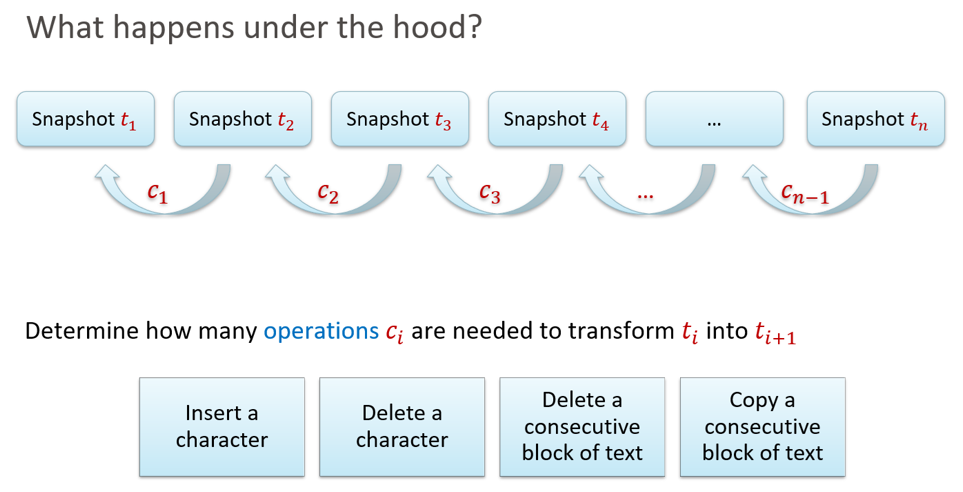
The aim of this project is to further develop and refine a prototype fraud detection tool that analyses the edit history of student submissions on the ANS educational platform. Initially created by the main applicant and a master's student in 2025, this innovative software examines the intermediate versions of an answer as it is being typed into a text box. By evaluating these histories, the tool can effectively distinguish between answers seamlessly pasted from external artificial intelligence sources and those generated through a student's authentic work. It specifically highlights instances where the largest textual jumps occur between versions, thereby identifying potential cheating without penalising honest students who might copy and paste text they previously wrote within the same box. The project will transform this initial prototype into a secure and user-friendly application suitable for broader adoption by other university teaching staff. Essential upgrades include improving data storage management, enhancing software installation processes, and writing comprehensive user documentation. Furthermore, the developers will introduce new functionality to automatically generate formal reports detailing suspected fraud, providing concrete evidence for examination committees. Ultimately, this project aims to create an efficient, rule-based monitoring system that allows graded homework to remain a viable and flexible tool for formative and summative assessment in the modern era of artificial intelligence.
This project is still ongoing.
For more information, please contact: