Project 5: Creating a Healthy Workplace
About this course
- Lecturers: Juliëtte van Duijnhoven, Leander van der Meij
- Academic level:
- Number of students:
- Number of ECTS: 5
- Disciplines:
- Status:
- Topic:
Set-up
This Multi-Disciplinary Challenge-Based Learning (CBL) project challenges students to develop an innovative, fully functional prototype that directly addresses real-world workplace wellness needs. Working in collaborative, multidisciplinary teams of six, students guide a project through the entire design journey. The developed prototype must target one or more key workplace health dimensions
- Physical environmental factors: Such as light, air, and sound.
- Psychosocial factors: Focusing on vitality, burnout, or behavioural interventions.
- Smart technology: Incorporating elements like wearables or software.
Every group that builds a prototype receives a material budget of up to €100, and the completed prototype remains the property of the university
Intended Learning Outcomes (ILO’s)
- You will develop essential skills in establishing meaningful design criteria, crafting detailed specifications, and navigating real-world constraints.
- You will learn to manage project timelines effectively.
- The project deepens your understanding of how environmental, psychological, and technological factors influence workplace health.
- You will build transferable skills in teamwork, critical analysis, and creative problem-solving to prepare you for complex interdisciplinary challenges in your future engineering career.
Assessment
This course used the following methods of assessment:
- Individual Assessment (weight 50%)
- Group Assessment (weight 50%)
- Intermediate Presentation (15%)
- Final Presentation, including a working prototype (20%)
- Group Report (15%)
Attendance at all on-campus group meetings and presentations is mandatory, and regular absences will negatively impact a student's individual evaluation.
Learning Activities
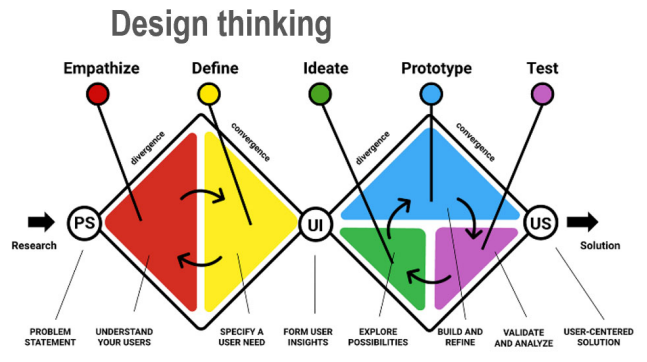
The project takes place over a nine-week timeline structured around the Design Thinking methodology.
- Week 1 (Kick-off & Team building): Introduction to the context and mapping the skills of the group members.
- Weeks 2–3 (Empathise & Define): Researching community challenges, collecting stakeholder insights, and creating a problem statement.
- Weeks 4–5 (Ideate): Brainstorming creative solutions and assessing feasibility, including a midterm assessment presentation.
- Weeks 6–7 (Prototype): Building and refining a physical prototype to test design assumptions.
- Weeks 8–9 (Test & Iterate): Conducting user testing, finalizing the solution, and presenting the working prototype at the final assessment.
Organisation of the course
The project mirrors professional engineering practice by incorporating specific workplace settings and structured supervision.
- Workplace Assignments: Teams are assigned to specific physical workplaces depending on their allocated timeslots, including locations such as Vertigo 2.24, the PROTO/zone in Matrix, the Light Assembly facility, or the Workplace Vitality Hub at the High Tech Campus Eindhoven.
- Structure: Teams will meet twice a week for structured group discussions, where they will review progress, share insights, and plan next steps. Between meetings, students will complete self-study assignments (SSA) to advance their work.
- Course Guidance: The course is coordinated by teachers Juliëtte van Duijnhoven and Leander van der Meij, supported by a network of student tutors assigned to specific group numbers.
- AI Policy: Students are allowed to use AI tools for supportive tasks such as brainstorming, summarizing, and grammar adjustments, but they are strictly prohibited from using AI to generate original content for their formal assignments.